How to Get Cited by ChatGPT
There is no submission form or markup that guarantees a citation in ChatGPT. A page must first be accessible to the relevant search crawler, then be retrieved for a specific query, judged useful, and selected as a source for the answer.
You can improve those conditions. The practical work combines technical access, unambiguous content, original evidence, passage-level structure, strong source identity, and independent authority.
This guide focuses on actions a publisher can verify instead of promises about an opaque ranking system.
How ChatGPT citations work at a high level
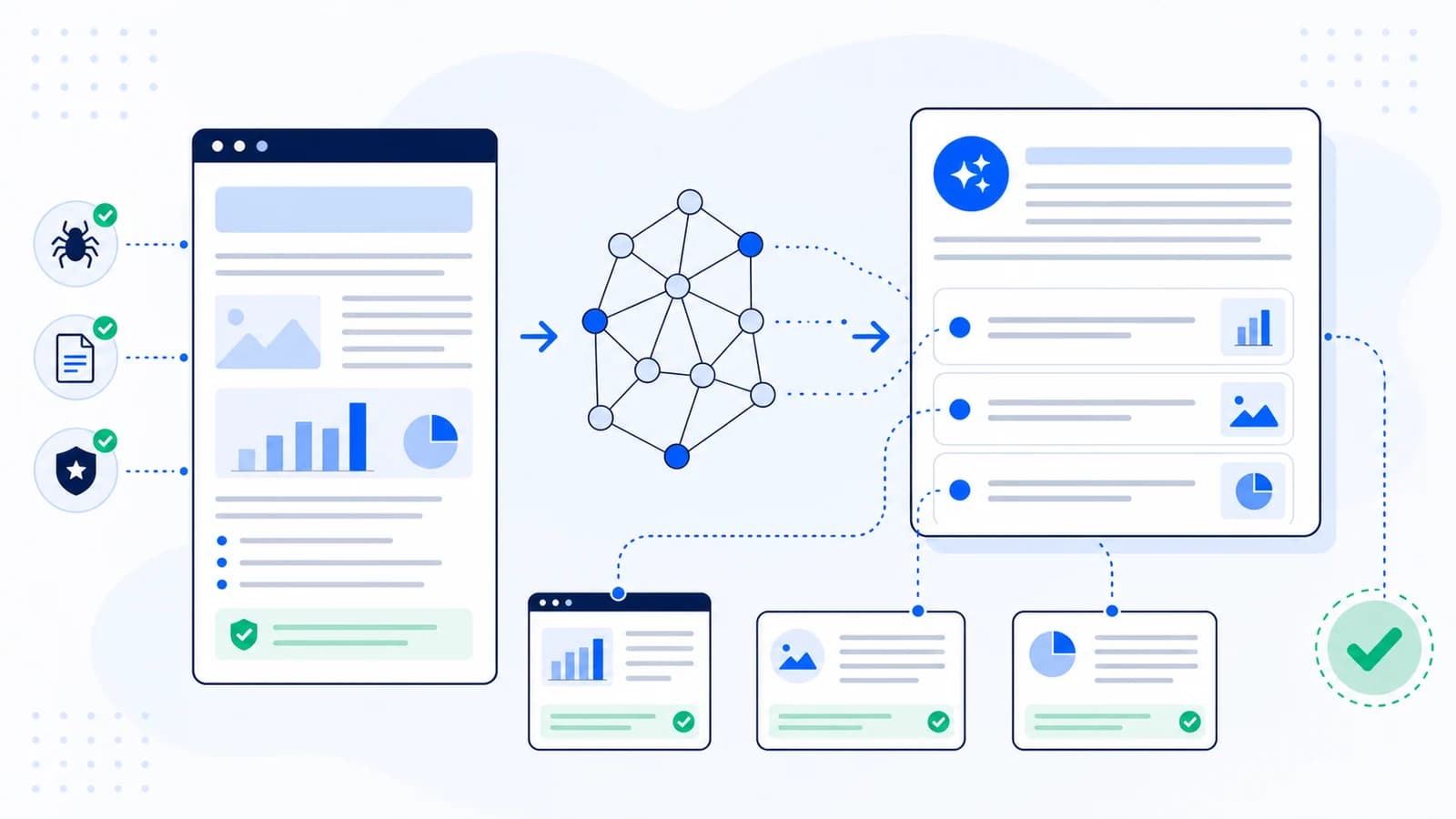
When a ChatGPT experience uses web search, the system can reformulate or expand the user's request, retrieve candidate pages, synthesize an answer, and attach sources that support it.
That means a page competes at several stages:
- Can the relevant crawler access it?
- Can the page be indexed or retrieved?
- Does it match one of the questions generated from the user's request?
- Is the relevant passage easy to identify and extract?
- Is the source credible enough for the claim?
- Does it add something more useful than competing pages?
Optimizing only a homepage or one broad keyword misses this retrieval process.
1. Allow the correct OpenAI crawler
OpenAI distinguishes OAI-SearchBot, used for search discovery, from GPTBot, associated with potential model-development crawling.
If you want content to be discoverable in ChatGPT search, OpenAI's publisher FAQ says not to block OAI-SearchBot. You can make a separate policy decision for GPTBot.
Example:
User-agent: OAI-SearchBot
Allow: /

User-agent: GPTBot
Disallow: /
This does not guarantee crawling or citation. It only removes one possible policy block.
Also inspect the CDN and web application firewall. A permissive robots file cannot override a 403, CAPTCHA, JavaScript challenge, rate limit, login wall, or regional block.
2. Make canonical pages technically retrievable
Important source pages should normally:
- return HTTP 200;
- use a stable HTTPS canonical URL;
- avoid unnecessary redirect chains;
- expose meaningful content in the initial response;
- have correct
robotsandX-Robots-Tagdirectives; - work for anonymous visitors;
- render well on mobile;
- use semantic headings, links, lists, and tables;
- load reliably without requiring a fragile client-side action.
Google's own guidance for AI search experiences similarly emphasizes accessible, indexable pages and standard search fundamentals rather than special AI-only files.
Run an AI-readiness audit to check crawler rules, HTTP behavior, structured data, sitemaps, Lighthouse signals, and llms files together.
3. Target questions, not just head terms
A user asking "What is the best analytics platform?" can trigger narrower research questions:
- Which tools support data residency in the EU?
- Which products are cookieless?
- What are the usage limits?
- How does migration work?
- Which claims are independently documented?
Create a topic cluster that answers the decision process, not 20 pages that repeat the same generic definition.
A useful content map includes:
- a definitive product or topic overview;
- comparison criteria;
- implementation guides;
- limitations and eligibility;
- current pricing or policy references;
- original research or first-party data;
- troubleshooting and edge cases.
Each page should have a distinct primary intent and link to the relevant supporting pages.
4. Put a direct answer near the question
AI retrieval often works at passage level. Make each important section understandable without requiring the entire page.
Use:
- descriptive question-based headings;
- a concise answer in the opening paragraph;
- lists for steps or requirements;
- tables for genuine comparisons;
- explicit units, dates, versions, and regions;
- definitions before acronyms;
- links to evidence close to the supported claim.
Avoid delaying the answer behind a long story, vague introduction, or sales pitch.
This does not mean writing for robots. A clear passage helps people scan the page as well.
5. Publish information worth citing
Rephrasing the top search results creates little reason to cite your version.
Stronger source material includes:
- an original dataset with methodology;
- a documented experiment;
- a benchmark with reproducible conditions;
- primary product specifications;
- expert commentary with identity and relevant experience;
- a current legal, technical, or policy interpretation linked to primary sources;
- a transparent case study with baseline and outcome;
- a calculator or reference table that solves a real task.
If you cannot add original data, improve the synthesis: define the scope, reconcile conflicting primary sources, show exceptions, and keep the conclusion current.
Do not invent survey results, customer numbers, benchmark scores, or quotations. Scaled low-value AI text can violate search spam policies and erode trust.
6. Make authorship and evidence visible
For topics where trust matters, identify:
- who wrote or reviewed the page;
- why that person or organization is qualified;
- publication and update dates;
- the methodology behind original claims;
- primary sources;
- conflicts of interest;
- correction and editorial policies.
An author box alone does not create expertise. The content and evidence must support it.
Keep important claims consistent across the website, company profiles, documentation, and reputable external references. Conflicting founding dates, product names, pricing, or leadership information create entity ambiguity.
7. Maintain freshness where freshness matters
Some facts age quickly: software versions, prices, laws, availability, crawler names, and platform behavior.
Use a real maintenance process:
- Identify time-sensitive fields.
- Assign an owner.
- Record the source and verification date.
- Update the visible page when facts change.
- Change the displayed modified date only after a substantive review.
- Redirect or archive obsolete competing pages.
Freshness is not an excuse to rewrite dates automatically. A current date on stale content weakens trust.
8. Use structured data correctly
Structured data can help systems identify an article, organization, author, product, FAQ, or breadcrumb structure. It must match visible page content and use a type appropriate to the page.
Useful checks:
- one stable organization identity;
- consistent name, URL, logo, and
sameAsreferences; - article author and dates that match the page;
- product data that matches visible price and availability;
- breadcrumbs matching navigation;
- no hidden FAQ markup for questions users cannot see.
There is no special "rank in ChatGPT" schema type. Treat claims to the contrary skeptically.
9. Build authority beyond your own domain
AI citations are not earned only through on-page formatting. Independent references help establish that a source and entity are worth trusting.
Authority can come from:
- original research cited by relevant publications;
- documentation referenced by developers;
- expert contributions to industry resources;
- reputable reviews and directories;
- standards participation;
- open data or tools that others use;
- consistent coverage from sources with genuine editorial review.
Avoid buying bulk low-quality mentions. They create noise, not evidence.
Digital PR works best when it promotes a citable asset: a dataset, benchmark, map, methodology, or expert finding.
10. Add llms.txt as a supporting layer
A concise llms.txt can identify the site's authoritative resources for tools that intentionally read it. It is not required for ChatGPT citation and should not be the first optimization step.
Publish it after:
- crawler access works;
- canonical pages are clear;
- the content cluster has distinct intent;
- facts and evidence are current;
- an owner can maintain the file.
Use the llms.txt generator to create a draft, then verify the live file rather than assuming deployment succeeded.
How to measure ChatGPT visibility
AI answers vary by date, location, product mode, personalization, and prompt wording. A useful measurement system records those variables.
Define a fixed prompt set
Group prompts by:
- category discovery;
- problem and use case;
- comparison;
- implementation;
- brand verification;
- current facts.
Include both branded and non-branded prompts. Avoid changing the set every time the result is disappointing.
Record source-level outcomes
For each test, capture:
- date and product mode;
- exact prompt;
- whether your brand appears;
- whether your domain is cited;
- which exact URL is cited;
- the claim supported by the citation;
- competing sources;
- factual errors or outdated statements.
Combine prompt tests with real traffic
Use analytics and server logs to measure referrals from AI products, landing pages, conversions, and requests from verified crawler identities. Respect privacy and do not over-interpret small samples.
Diagnose the missing stage
If the page is not cited, ask:
- Is access blocked?
- Is the page indexed and canonical?
- Does it answer the generated sub-question?
- Is the passage specific and extractable?
- Is the evidence stronger than competitors?
- Is another page on your site causing ambiguity?
This turns "AI visibility" into concrete work.
A 30-day implementation plan
Week 1: Access and baseline
- Audit
OAI-SearchBot, HTTP, WAF, indexing, canonical, and rendering. - Export current AI referrals and crawler logs.
- Define 30 to 50 representative prompts.
- Record current sources and visibility.
Week 2: Content architecture
- Map prompts to existing canonical pages.
- merge or differentiate pages with overlapping intent;
- identify missing comparison, implementation, and evidence content;
- strengthen internal links and page summaries.
Week 3: Evidence and presentation
- Add original data, methodology, examples, or expert review.
- Rewrite important sections with direct answers.
- Correct authorship, dates, citations, and structured data.
- Improve accessibility and semantic HTML.
Week 4: Distribution and measurement
- Publish or update the strongest source asset.
- Promote it to genuinely relevant publications and communities.
- Add llms.txt if the curated source map is ready.
- Repeat the prompt set and review crawler/server logs.
- Schedule 30-, 60-, and 90-day reassessments.
Do not expect a controlled SEO experiment to produce a universal conclusion in four weeks. The first month establishes a stronger technical and editorial system.
Common mistakes
Publishing hundreds of generic AI-written pages
Volume does not create unique evidence. It can introduce factual errors, cannibalization, and low-value scaled content.
Blocking search crawlers while optimizing metadata
Schema and llms.txt cannot help a client that cannot retrieve the source.
Hiding the answer behind interactivity
Critical facts inside a calculator, image, or client-only widget need an accessible textual explanation.
Treating every AI bot as the same
Search discovery, model development, and user-initiated retrieval have different controls and business implications.
Reporting a visibility score without its prompt set
A score is meaningful only with documented prompts, dates, regions, products, and methodology.
Frequently asked questions
Can I submit my website directly to ChatGPT?
There is no general submission mechanism that guarantees inclusion or citation. Make the site accessible to the relevant search crawler and improve the quality and authority of its canonical sources.
Does ChatGPT use Google rankings?
Do not assume a simple one-to-one relationship. Strong search fundamentals help make pages accessible and understandable, but ChatGPT's retrieval and citation choices are product-specific.
How long does it take to earn a citation?
There is no guaranteed timeline. Crawling, retrieval, query demand, source quality, freshness, and competition all vary.
Do backlinks help ChatGPT citations?
Relevant independent references can strengthen discoverability and authority, but a link count alone does not guarantee a citation. The page still needs to answer the retrieved question.
Is llms.txt required?
No. It is an optional, emerging convention and a supporting source map, not a ChatGPT ranking directive.
Source notes
- OpenAI publisher and developer FAQ: https://help.openai.com/en/articles/12627856-publishers-and-developers-faq
- Google guidance for succeeding in AI search: https://developers.google.com/search/blog/2025/05/succeeding-in-ai-search
- Google guidance on generative AI content: https://developers.google.com/search/docs/fundamentals/using-gen-ai-content
- Ahrefs analysis of LLM citation characteristics: https://ahrefs.com/blog/llm-citations/
- Internal GEO guide:
/blog/generative-engine-optimization/